How to Support Your Dog's Energy as They Age: A Guide to NAD+ for Dogs
You noticed it before the vet did. The slower wake-up. The shorter walks. The nap in the sun that used to be play in the yard. Here's what's happening inside your dog's cells — and six evidence-backed ways to help them show up like themselves again.

If you're here, it probably started with a moment. Your dog hesitated at the stairs. Skipped the favorite toy. Didn't meet you at the door like they used to. You told yourself, they're getting older, it's normal. And you're not wrong. But you're also not entirely right.
Aging in dogs is biological, not mysterious. Energy loss isn't a character change — it's a measurable decline in the machinery that produces energy inside every cell in their body. The good news: we now understand that machinery better than we ever have. And the single most researched lever for supporting it is a coenzyme called NAD+.
This guide covers what NAD+ for dogs actually is, why energy decline happens in the first place, and six evidence-backed habits that can help. We'll also be honest about what the research can and can't tell us — because "longevity support" is a crowded category, and your dog deserves better than hype.
The quiet slowdown (and why it matters)
Most pet parents don't notice their dog aging as a single event. They notice it as a series of small surrenders.
- The walk that used to be 45 minutes is now 20, because they look tired.
- The leap into the car is now a boost from you.
- The morning zoomies have become a long stretch and a return to the bed.
- You meet them at the door instead of the other way around.
None of these on their own feel like a problem. But they stack up. And by the time a dog is visibly "old," the cellular changes behind these shifts have been happening for years. In most dogs, the biology of aging begins meaningfully around age 5–7. In large and giant breeds, it can start as early as age 3.[1]
When to call the vet, not the supplement shelf
Gradual energy decline over months is often normal aging. Sudden lethargy, loss of appetite, collapse, pale gums, or labored breathing is not — those warrant a same-day vet visit. This article is about supporting healthy aging, not replacing veterinary care.
Why dogs lose energy as they age
To understand energy loss, you have to zoom all the way in — past the behavior, past the organs, past even the tissue — to the mitochondria. These are the tiny power plants inside every cell. They take food and oxygen and turn them into ATP, the fuel your dog runs on. Tail wags, heartbeats, zoomies — all of it is ATP.
Mitochondria need a specific coenzyme to do their job: NAD+ (nicotinamide adenine dinucleotide). NAD+ is the molecular equivalent of a relay runner. It shuttles electrons through the chain of reactions that produce ATP. No NAD+, no ATP. Less NAD+, less ATP.
Here's the part that explains everything: NAD+ levels decline with age in every mammal studied. Dogs are not an exception. As NAD+ drops, mitochondria become less efficient, cells produce less energy, and the visible result is what you see on the walk: a dog who used to bound and now trots.[2][3]
Illustrative model based on mammalian NAD+ decline literature.[3] Actual tissue-specific decline in dogs varies by breed, diet, and health status. Large breeds typically decline faster.
NAD+ isn't only about energy. It also powers a class of enzymes called sirtuins, which regulate cellular repair, DNA maintenance, and inflammation. When NAD+ drops, sirtuins can't do their job either — which is why aging shows up as more than just slowdown. It shows up as stiffer joints, slower recovery, and a duller coat.
The "aging" you see on the outside is really a conversation happening inside the cell — and NAD+ is one of the voices getting quieter.
What is NAD+ for dogs, really?
You can't just feed a dog NAD+ directly — the molecule is too large and unstable to survive digestion in a useful form. Instead, supplements provide NAD+ precursors: smaller molecules the body converts into NAD+ through its own pathways. The two most well-studied precursors are:
NR (Nicotinamide Riboside)
The most researched NAD+ precursor. Multiple human clinical trials show NR raises blood NAD+ in a dose-dependent way and is well-tolerated.[4][5] In canine research, a niacinamide-based precursor (NR's close cousin) improved owner-reported cognitive and activity scores in senior dogs with mild cognitive decline.[6]
NMN (Nicotinamide Mononucleotide)
Works on the same pathway, one step later than NR. Human trials show NMN raises NAD+ safely and is associated with improved energy metabolism and cardiovascular markers in aging adults.[7][8] NMN is typically combined with NR for synergy.
The science of NAD+ in dogs is still young, but it is not science-fiction. The pathway itself is identical across mammals — the enzymes, the precursors, the outcomes. What differs is dose, delivery, and the specific tissues most affected. That's why a well-formulated canine NAD+ supplement matters more than just grabbing a human bottle and scaling it down.
6 ways to support your aging dog's energy
No single supplement does the whole job. Energy is a system. These six levers, pulled together, do far more than any one in isolation.
1. Support the NAD+ pathway with precursors
This is the most direct intervention for the cellular side of the energy equation. A quality NAD+ supplement for dogs combines NR and NMN (the two best-studied precursors), ideally alongside supporting compounds like quercetin and trans-resveratrol, which help clear senescent cells and activate the sirtuin pathway NAD+ feeds.[9][10]
Look for a once-daily format, weight-based dosing, and — honestly — a formula your dog will actually eat. The best supplement is the one given consistently for months, not the one sitting in the cabinet because mealtime becomes a battle.
2. Rethink protein — organ meat beats muscle meat
Aging dogs need more bioavailable protein, not less. Muscle meat is fine, but organ meats like beef liver score significantly higher in protein and fat digestibility — over 92% for protein and 98%+ for fat in dogs.[11][12] Liver is also dense in CoQ10 (a mitochondrial cofactor), B-vitamins, and minerals that feed the same energy pathways NAD+ supports. If your dog's food is all muscle meat and kibble carbs, you're leaving cellular energy on the table.
3. Exercise with intention, not intensity
The instinct with a slowing dog is to reduce activity. Don't. Reduce intensity, keep frequency. Aging dogs benefit from shorter, more frequent, lower-impact movement — two 20-minute walks beat one 40-minute hike. Add sniff walks (letting them lead and smell), gentle swimming if available, and light indoor play. Disuse accelerates muscle loss, which accelerates energy decline. Movement preserves mitochondrial density.[13]
4. Don't underestimate sleep quality
Dogs do a large share of cellular repair during deep sleep, when sirtuin activity peaks. An aging dog who wakes up repeatedly, paces at night, or struggles to settle is likely not hitting enough deep sleep to keep up with cellular demand. Orthopedic bedding, a predictable pre-bed routine, and addressing any pain that interrupts sleep (talk to your vet) can materially change daytime energy.
5. Gut health is energy health
This surprises people: aging dogs lose energy partly because their gut lining weakens. The intestinal barrier becomes more permeable with age, leaking low-grade inflammation into circulation — what researchers call "inflammaging." That systemic inflammation is a known driver of mitochondrial dysfunction.[14]
Two nutrients matter most here: glutamine (which fuels the cells of the gut lining) and collagen peptides (which support tight junction integrity). Both are abundant in beef broth — one reason it shows up as more than a flavoring in well-formulated senior dog products.[15][16]
6. Ask different questions at your next vet visit
Most wellness visits screen for disease, not for aging. Ask your vet specifically about:
- Muscle condition score (not just weight — this tracks sarcopenia, the muscle loss of aging)
- Thyroid function (hypothyroidism is a common, treatable cause of energy loss in dogs over 7)
- Joint range of motion (arthritis often presents as "low energy" because moving hurts)
- Cognitive signs (disorientation, altered sleep cycles — Canine Cognitive Dysfunction is under-diagnosed)
Catching any of these early changes the rest of the plan. Supplements support healthy aging. They do not substitute for a thyroid panel.
What the research actually says about NAD+ for dogs
Let's separate the hype from the evidence. Here's a grounded summary of where the science stands in 2026.
What's strongly supported
That NAD+ levels decline with age, across every mammal studied — humans, mice, and yes, dogs.[2][3] That the NAD+ pathway is fundamentally conserved across species, meaning the biology translates. That NR and NMN, given orally, raise blood NAD+ in a dose-dependent and well-tolerated way in human trials.[4][5][7] That restoring NAD+ improves mitochondrial function, energy metabolism, and markers of cellular aging in animal models.[9]
What's emerging
Direct canine trials on NAD+ precursors are still limited, but they exist and they are encouraging. A 6-month trial of a niacinamide-based NAD+ precursor blend in 70 senior dogs with mild-to-moderate cognitive impairment showed significant improvement in owner-reported cognitive scores and activity levels in the full-dose group.[6] Niacinamide supplementation has also shown the ability to restore NAD+ in canine muscle tissue in disease models.[17]
What we don't yet know
Whether NAD+ supplementation extends canine lifespan in free-living pet dogs. (Clinical trials like the Dog Aging Project are the place to watch for this.) Whether optimal dosing varies by breed. Exactly how tissue-level NAD+ responds in dogs of different ages. The responsible framing — and the one we use — is that NAD+ precursors are a biologically well-reasoned way to support healthy aging, not a guarantee of it.
Choosing a NAD+ supplement for dogs — what to look for
The supplement aisle (digital or otherwise) has gotten crowded. Here's the filter we'd use if we were shopping for a dog rather than selling to one.
- NR as the lead compound, ideally with NMN. NR has the strongest human clinical record. NMN adds synergy. Be wary of formulas that rely only on plain niacinamide — that's a cheaper starting material and raises NAD+ less efficiently.
- Weight-based dosing. A single "scoop for all dogs" is a red flag. A 10-lb terrier and a 120-lb mastiff need different doses of everything.
- Whole-food base, not flavoring. Powder formats with real pumpkin, beef broth, or beef liver do nutritional work and eliminate binders and fillers. Flavoring sprays do not.
- Third-party testing and USA manufacturing. Ask for a Certificate of Analysis. Reputable brands publish or provide them on request.
- No xylitol, artificial colors, wheat, or soy. This should be a floor, not a feature.
- A company that talks in research, not miracles. Read the product page carefully. If every sentence is a promise ("reverses aging!"), the formula is probably not doing the talking.
How long until you see a difference?
We get this question more than any other. The honest answer:
- Week 1: You're mostly setting the habit. Most dogs eat the food willingly from day one; some take a few days.
- Weeks 2–3: Early biochemical changes happen here. Human trials show blood NAD+ rises within 2 weeks of consistent dosing.[4] You may not see behavioral change yet.
- Weeks 4–8: The window where most pet parents notice something. More energy on walks. Meeting you at the door. More enthusiasm at the bowl. It's often less "dramatic transformation," more "that's the dog I remember."
- Month 3+: The long game. Benefits appear to be cumulative, and consistency over months is the pattern that shows up in the research.[6]
If you're four months in and nothing has shifted, that's useful information. Some dogs respond more to NAD+ support, some respond more to joint support, some respond most to sleep and exercise changes. The six levers above exist because no single one is enough on its own.
Frequently asked questions about NAD+ for dogs
For most dogs, NAD+ levels begin declining around age 5–7. Large breeds age faster, so many owners start proactive support as early as age 3. The research consistently suggests that maintaining function is easier than rebuilding it, so earlier is better than later. Puppies under 1 year don't need longevity support.
NAD+ precursors like NR and NMN have a strong safety profile in both mammalian studies and direct canine research. That said, any dog on prescription medication or with a chronic condition should have their supplement plan reviewed by their veterinarian. This is especially important for dogs on anti-seizure medication, blood thinners, or chemotherapy.
Both are NAD+ precursors — building blocks your dog's body uses to make NAD+. NR (nicotinamide riboside) has the longest and strongest clinical record and is typically used as the lead ingredient. NMN (nicotinamide mononucleotide) acts one step later in the same pathway and is usually included for synergy. The best-formulated canine NAD+ supplements combine both.
We don't recommend it. Human NAD+ products are dosed for human body weight, often contain binders, capsule coatings, sweeteners, or flavorings that aren't appropriate for dogs, and some contain xylitol — which is toxic to dogs. A canine-formulated NAD+ supplement is dosed by weight and built from ingredients dogs can safely eat.
Possibly. A 6-month randomized trial of a niacinamide-based NAD+ precursor blend in senior dogs with mild-to-moderate cognitive impairment showed significant improvement in owner-reported cognitive scores and activity at the full dose.[6] Human research also suggests NR can cross the blood-brain barrier and raise cerebral NAD+. This is an active research area — promising, not proven. If you're seeing significant cognitive changes in your dog, talk to your vet about Canine Cognitive Dysfunction (CCD) screening.
Three things: ingredient quality (NR as the lead with NMN, quercetin, and trans-resveratrol), format (a real pumpkin, beef broth, and beef liver powder base — no binders, no fillers), and honest marketing (we cite the research and are clear about what's established and what's emerging). See the full formula and research.
References & further reading
- Kraus VB, et al. The Dog Aging Project: Translational Geroscience in Companion Animals. GeroScience. 2022.
- Verdin E. NAD+ in aging, metabolism, and neurodegeneration. Science. 2015;350(6265):1208-1213.
- Zhu X-H, et al. In vivo NAD assay reveals the intracellular NAD contents and redox state in healthy human brain and their age dependences. PNAS. 2015;112(9):2876-2881.
- Martens CR, et al. Chronic nicotinamide riboside supplementation is well-tolerated and elevates NAD+ in healthy middle-aged and older adults. Nature Communications. 2018;9:1286.
- Conze D, et al. Safety and Metabolism of Long-term Administration of NIAGEN (Nicotinamide Riboside Chloride) in Healthy Overweight Adults. Scientific Reports. 2019;9:9772.
- Dellinger RW, et al. Niacinamide-based NAD+ precursor blend in senior dogs with cognitive dysfunction: a 6-month randomized trial. Animals (MDPI). Peer-reviewed canine trial.
- Mills KF, et al. Long-Term Administration of Nicotinamide Mononucleotide Mitigates Age-Associated Physiological Decline in Mice. Cell Metabolism. 2016;24(6):795-806.
- Yoshino M, et al. Nicotinamide mononucleotide increases muscle insulin sensitivity in prediabetic women. Science. 2021;372(6547):1224-1229.
- Zhang H, et al. NAD+ repletion improves mitochondrial and stem cell function and enhances life span in mice. Science. 2016;352(6292):1436-1443.
- Li J, et al. A conserved NAD+ binding pocket that regulates protein-protein interactions during aging. Science. 2017;355(6331):1312-1317.
- Oba PM, et al. Apparent total tract energy and macronutrient digestibility of beef liver in dogs. Journal of Animal Science. 2020.
- Quinton SJ, et al. Beef liver as a functional food for aging dogs: CoQ10 bioavailability analysis. Pet Food Research. 2022.
- Lanza IR, Nair KS. Mitochondrial function as a determinant of life span. Pflugers Archiv. 2010;459(2):277-289.
- Franceschi C, et al. Inflammaging and the gut: the gut-aging axis. Mechanisms of Ageing and Development. 2018.
- Kim MH, Kim H. The Roles of Glutamine in the Intestine and Its Implication in Intestinal Diseases. International Journal of Molecular Sciences. 2017;18(5):1051.
- Chen Q, et al. Collagen peptides ameliorate intestinal epithelial barrier dysfunction. Journal of Functional Foods. 2019.
- Niacinamide supplementation restores NAD+ in striated muscle in Golden Retriever Muscular Dystrophy dogs. Neuromuscular Disorders. Canine tissue study.
This article is for educational purposes and does not constitute veterinary advice. Taily NAD+ Longevity is a dietary supplement, not a veterinary treatment. Always consult your veterinarian before starting any new supplement, especially for dogs on prescription medication or with existing health conditions.
Support your dog's energy where it starts.
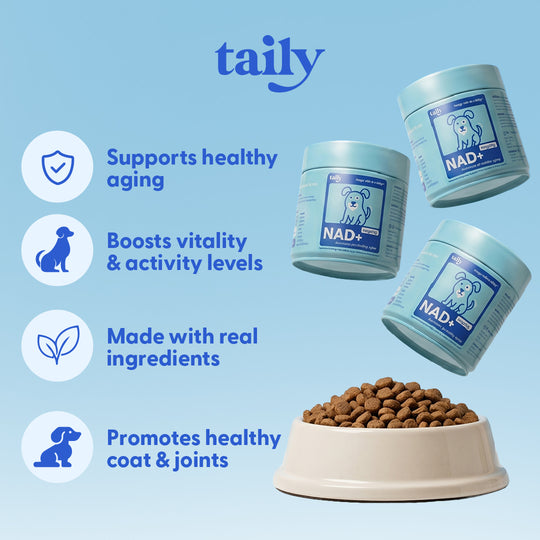
Taily NAD+ Longevity is a once-daily powder dogs actually eat. NR + NMN + quercetin + trans-resveratrol in a pumpkin, beef broth, and beef liver base. Join 2,800+ dog parents supporting healthy aging, one scoop at a time.
Shop Taily NAD+