What Is NAD+? A Plain-English Guide for Dog Owners
You’ve seen the acronym on supplement bottles and heard it mentioned in longevity research. Here’s what NAD+ actually is, why it matters for your aging dog, and what the science does — and doesn’t — support.
NAD+ (nicotinamide adenine dinucleotide) is one of the most important molecules in any living cell. It helps cells produce energy and repair damage. By the time a dog reaches senior age, their NAD+ levels have dropped significantly — which is part of why aging shows up the way it does.
You can’t just swallow NAD+ directly. Supplements use precursors (mainly NR and NMN) that the body uses to build NAD+ back up. The research is promising and moving fast, but still young — especially in dogs. This guide walks through what’s actually known, what to look for in a real product, and where the honest line is between science and marketing.
What is NAD+, exactly?
Every cell in your dog’s body runs on energy. That energy comes from mitochondria — tiny compartments inside each cell that convert food into the chemical your cells actually use as fuel. None of this is optional. If your dog’s cells stop making energy, your dog stops doing anything.
NAD+ (nicotinamide adenine dinucleotide) is a molecule that sits right at the center of that process. Scientists call it a coenzyme — a helper molecule that lets certain enzymes do their jobs. NAD+’s jobs are huge: producing energy from food, repairing damaged DNA, and regulating a family of cellular “caretaker” proteins called sirtuins that keep cells running cleanly over time.
Think of NAD+ as the charger cable that lets your dog’s cells stay plugged in and running. Without enough cable, even a full battery of food isn’t much use.
NAD+ isn’t rare or obscure. It shows up in every textbook on cellular biology, and its role in energy metabolism has been understood for nearly a century. What’s changed recently is our understanding of how NAD+ levels change over a lifetime — and what happens when they drop.
Why NAD+ declines with age
Here’s the finding that kicked off most of the current research: NAD+ levels drop significantly as animals age. This has been observed consistently across species — mice, humans, dogs — in multiple tissues. By the time an animal reaches what we’d call senior age, NAD+ levels in many tissues can be roughly half of what they were in youth.
by senior age across tissues
for most medium to large breeds
NAD+ supports directly or indirectly
Why does it drop? Some of it is reduced production. Some is increased consumption — aging cells burn through NAD+ faster trying to repair the cumulative damage they’ve accumulated. The exact reasons are still being worked out, but the pattern is one of the most well-documented cellular signatures of aging we have.
This decline shows up in ways you can see at home. Cells with less NAD+ produce less energy, recover slower, and lose some of their ability to keep housekeeping in order. That translates — eventually — into what we recognize as aging. Slower recovery after exercise. Lower baseline energy. Less engagement. The cell-level story and the dog-bed-level story are connected.
Imagine your dog’s cells are each running on rechargeable batteries. When they’re young, they charge fast and hold a lot. As they age, the charging system gets slower and the batteries drain quicker. That’s what dropping NAD+ looks like at the cellular level.
NAD+ precursors: NR vs. NMN
Here’s the important bit a lot of marketing glosses over: your dog’s body can’t absorb NAD+ directly from a supplement very well. The NAD+ molecule is too large and gets broken down in digestion before it ever reaches the cells that need it.
What actually works is supplementing with the building blocks the body uses to make NAD+ on its own. Those building blocks are called precursors. The two most-studied precursors are NR and NMN.
A form of vitamin B3 that converts to NAD+ through a relatively direct pathway. The most-researched NAD+ precursor, with multiple human clinical trials supporting its safety and effectiveness at raising NAD+ levels.
A close chemical cousin to NR, one step closer to NAD+ in the biochemical pathway. Younger research base, but growing fast — many of the most-cited longevity studies in animal models use NMN specifically.
Well-formulated stacks often use both precursors together because they travel slightly different paths to the same destination — and emerging evidence suggests the combination can be more effective than either alone.
What about NAD+ IV therapy?
You may have heard about NAD+ IV infusions in the human longevity world — clinics that drip NAD+ directly into the bloodstream, bypassing the digestion problem entirely. Those exist in veterinary medicine too, but they’re rare, expensive, require a clinical setting, and are generally reserved for specific medical contexts rather than daily longevity support.
For a dog living their life at home, an oral precursor supplement is the practical path. Lower cost, no needles, and consistent daily support rather than intermittent spikes.
Does this actually work in dogs?
Honest answer: the research is promising but still young, and you should be skeptical of anyone who tells you otherwise. Here’s what we actually know.
What’s well-established
The underlying biology — that NAD+ declines with age and that supplementing with precursors can raise it back up — is about as solid as cellular biology gets. This has been shown in mice, rats, monkeys, and humans across many independent studies. NR and NMN both reliably raise NAD+ levels in blood and tissues.
What’s strongly suggested by animal research
Restoring NAD+ in aged animals has been associated with improvements in mitochondrial function, exercise capacity, metabolic markers, and various measures of healthy aging across multiple studies. These results aren’t from a single lab — they’ve been replicated broadly. It’s why the entire human longevity industry took this category seriously in the first place.
What’s specifically known about dogs
Here’s where things get thinner. Dogs share the underlying biology — same NAD+ pathways, same mitochondria, same age-related decline. So there’s strong biological plausibility that what works in the underlying system should work in dogs. Pharmacokinetic data in dogs supports that NR and NMN are absorbed and raise NAD+ levels in canine tissues much as they do in other mammals.
But the number of published canine clinical trials specifically on NAD+ precursors for aging outcomes is still small. This is an area getting serious research attention right now, and the data is improving fast — but anyone telling you “it’s proven to reverse aging in dogs” is overselling the current evidence.
If a brand is promising miracles, walk away. If a brand is transparent about what the research does and doesn’t yet prove — and still finds the category worth investing in — you’re probably dealing with someone honest. We’d rather be in that camp.
What to look for in a real product
Here’s the practical part. The NAD+ supplement market is a mix of serious research-backed stacks and cash-grab products riding the trend. These are the signals that separate the two.
- Transparent mg dosing of NR and NMN, listed individually on the label.
- Meaningful doses that reflect the research — not trace amounts masked by a big bottle.
- Complementary antioxidants (trans-resveratrol, quercetin) that support NAD+ activity.
- A palatable base using real foods — pumpkin, bone broth, liver.
- Made for dogs, not repackaged human supplements.
- Clear third-party testing or a quality guarantee from the manufacturer.
- “Proprietary blends” that hide individual ingredient amounts.
- Under-dosed formulas with tiny mg amounts stretched across an impressive-looking ingredient list.
- Artificial flavors & colors, fillers, binders, or mystery “natural flavorings.”
- Any xylitol — it’s toxic to dogs and shouldn’t be anywhere near a canine supplement.
- Miracle claims like “reverses aging” or “add years to your dog’s life.”
- Brands that won’t tell you who formulated the stack or where it’s manufactured.
A note on dosing
Meaningful NR doses for medium-sized dogs tend to fall in the range of 50–150 mg per serving, with NMN often in the 25–75 mg range. These aren’t hard rules — body weight, formulation, and the supporting ingredients all factor in — but they give you a reference point. If a product lists doses dramatically lower than that, it’s either extremely small-dog-specific or riding the category without the substance.
And remember: the best formula in the world is useless if your dog won’t eat it. Palatability isn’t a nice-to-have. If your dog refuses the supplement on day seven, the research-level dosing doesn’t matter.
What NAD+ supplements can’t do
This section matters because the category attracts both honest science and overblown marketing. Here’s what not to expect, so you can spot a product making claims it can’t back up.
They’re not a treatment for disease.
NAD+ precursors don’t cure cancer, reverse kidney failure, restore failing heart function, or heal a torn ligament. If your dog has a diagnosed condition, a supplement is a complement to veterinary care, not a replacement.
They won’t turn your 12-year-old Labrador into a puppy.
The goal of longevity support is to help your dog be more of themselves, more consistently — not to de-age them. Results look like better engagement, more consistent energy, a dog who still meets you at the door. Not a dog who’s suddenly acting like they’re three again.
They don’t work in three days.
The biological processes NAD+ supports happen slowly. Most pet parents who see meaningful results start noticing changes around weeks 4–8, with deeper benefits compounding over months of consistent use. A supplement you’re giving sporadically isn’t really a supplement — it’s a placebo.
They’re not a substitute for the basics.
A senior dog’s longevity is built out of weight management, daily movement, good nutrition, veterinary care, and mental stimulation. Those do far more than any supplement can. Add NAD+ support on top of those foundations — never as a replacement for them.
NAD+ FAQ
Most pet parents start somewhere between age 5 and 7, or earlier for large and giant breeds who age faster. There’s no hard rule. If your adult or senior dog is showing signs of slowing down — less energy, longer recovery after walks, less engagement — that’s a reasonable moment to consider it. For puppies under a year, skip it. They don’t need longevity support yet.
NR and NMN have strong safety profiles across multiple studies in humans and animal models. Occasionally dogs may experience mild digestive adjustment in the first week or two — softer stool, slightly reduced appetite — which typically resolves as their system adjusts. If your dog is on prescription medication or has a diagnosed condition, talk to your vet before starting any new supplement.
Most pet parents notice subtle changes around weeks 4–8 of consistent daily use. Earlier than that, any changes you’re seeing may be noise or placebo. The deeper benefits compound over months. NAD+ isn’t a fast-acting supplement — it’s a daily-consistency one.
Both are precursors the body converts into NAD+. NR is one step further upstream in the biochemical pathway, with more established clinical research behind it. NMN is one step closer to NAD+ and has a strong body of animal-model research. Many well-formulated stacks use both because they travel slightly different paths, and the combination can be more effective than either alone.
Generally yes — NAD+ precursors work through a different mechanism than joint support or omega-3s, so they don’t compete. Many pet parents stack them. If your dog is on any prescription medication, check with your vet about interactions. Introduce one new supplement at a time so you can tell what’s doing what.
Technically it’s safe, but it’s not necessary. Young dogs already produce healthy NAD+ levels on their own. Save the supplementation for when the research-supported benefit actually applies — adult and senior age. For a puppy, focus on good food, exercise, and vet care.

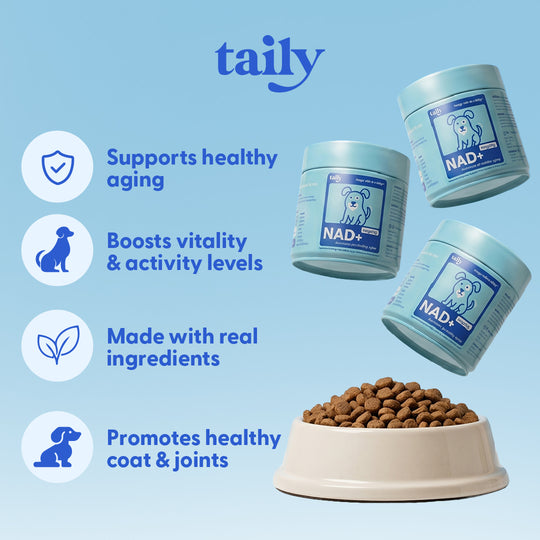
Taily NAD+ longevity
Transparent doses of NR and NMN, stacked with quercetin and trans-resveratrol, in a pumpkin and beef broth base dogs actually want to eat. No proprietary blends. No fillers. No miracle claims.